

Pets abandoned in their thousands: the dark side of summer in France
You know it’s summer here in France when a) the France 24 newsroom gradually begins to empty, b) the train home is packed with sleepy tourists on their way back from Versailles and c) French animal welfare organisations are desperately trying to dissuade people from abandoning their pets.
According to the animal welfare group 30 millions d’amis (30 million [furry] friends), no less than 60,000 pets are abandoned in France every year during the summer holidays. The Paris-based Société Protectrice des Animaux (Animal Protection Society), which runs shelters nationwide, reckons the figure is even higher: a whopping 100,000 animals abandoned by their owners.
I spoke to Marion Giroud of the Confédération Nationale des SPA de France, which federates its own network of animal shelters nationwide. “People don’t think about the constraints” when they buy a pet, she told me in a telephone interview. Although going on holiday would appear to be a pretty obvious one, it only seems to dawn on some pet owners when it’s already too late. Seemingly unable to find a kennel, a pet-sitter or to take their pet with them, they then choose to abandon said pet rather than miss out on their vacation. “Some of them phone us up just before their holiday, saying that all the kennels are full”, Giroud explains. Although she acknowledges that there are not enough kennels and catteries in France, she points out that pet-sitting services offered by individuals are now easy to find online (one such website is Tendea).

A Samoyed dog. Every year, as many as 100,000 pets are abandoned in France. © Caroline Clarkson
The shocking figure of 100,000 abandonments covers two types of situation: those pets handed over to a shelter by their owners, plus those animals which are unceremoniously dumped and later found. That’s right: not all owners go to the trouble of tracking down a shelter for their former furry friend. “We find cats with their ears cut so that they can’t be traced by their earmark, dogs tied to trees, and indoor cats dumped in the countryside”, Reha Hutin, the head of 30 millions d’amis, told the website of free newspaper 20 Minutes. Hutin adds that these days, even small animals such as gerbils and hamsters are being abandoned.
Let’s try to compare these figures with those for the UK, for example. Last year, the RSPCA (Royal Society for the Prevention of Cruelty to Animals), received 28,000 calls from the public about abandoned animals. But this figure does not take into account those pets handed over to shelters by their owners. This is because the RSPCA takes in animals it has rescued; it does not take in unwanted animals like a typical shelter.
Like I say, abandonment is such a problem here in France that animal welfare groups run public awareness campaigns every summer. This year, 30 millions d’amis has chosen the tagline “An animal doesn’t cry.... It suffers in silence", as shown just below.
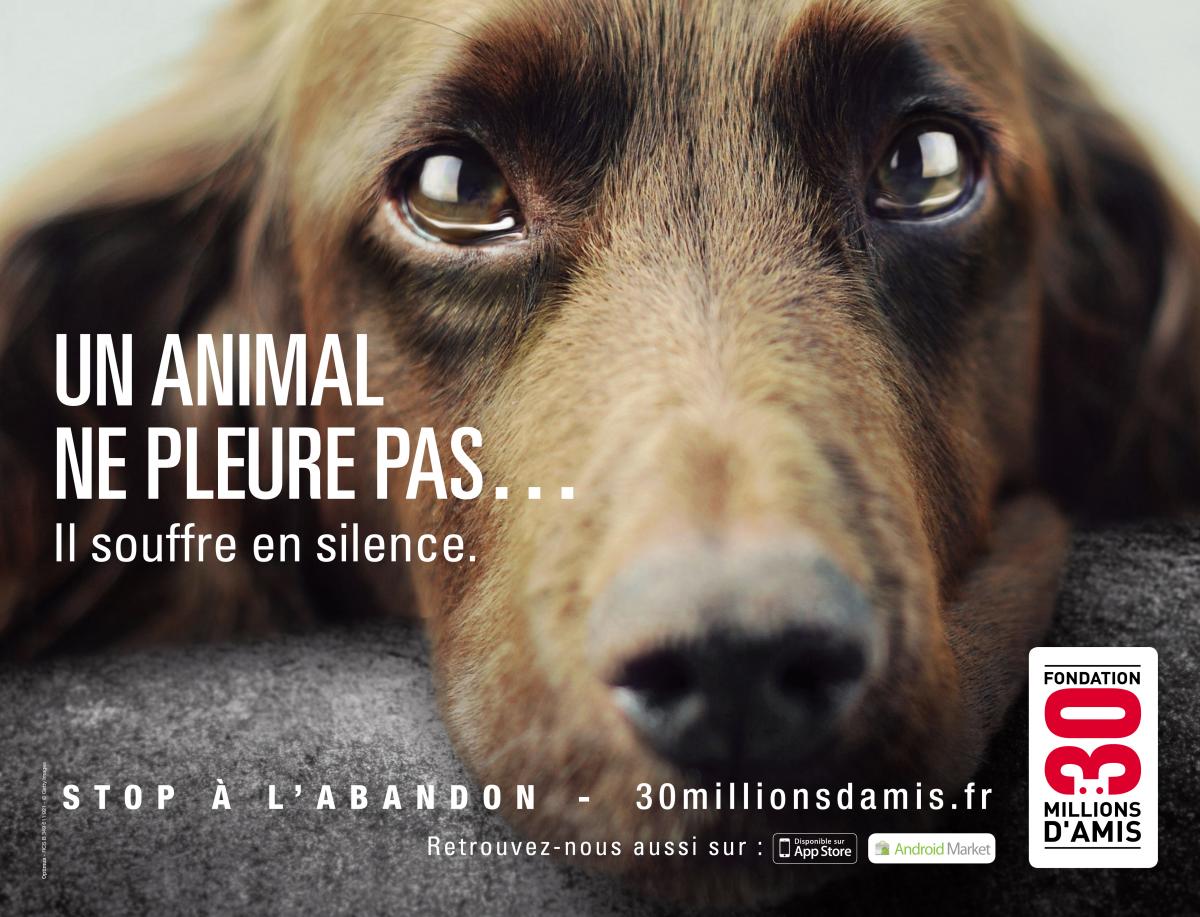
This year's campaign poster by 30 millions d’amis.
So why are the figures still so high despite all these years of campaigning? To try to understand the reasons for abandonment, 30 millions d’amis carried out a survey of shelters back in 2008. The results are enlightening: 9 out of 10 dogs abandoned are large dogs, two thirds of all animals abandoned are adults, and 7 out of 10 dogs abandoned are mongrels. All of which tends to suggest that too many people are (still) falling for that cute puppy or kitten in the window, without thinking ahead about how to care for it.
Marion Giroud confirms this impression. “We live in a consumer society and a pet is often an impulse buy”, she says. “It even happens that people who have just bought a pedigree animal - at considerable cost - abandon it at a shelter a few days later, having realised they cannot look after it”. Giroud also points out that in Germany, where there are fewer abandonments, dog owners have to pay a tax, which may well be helping to reduce impulse buying.
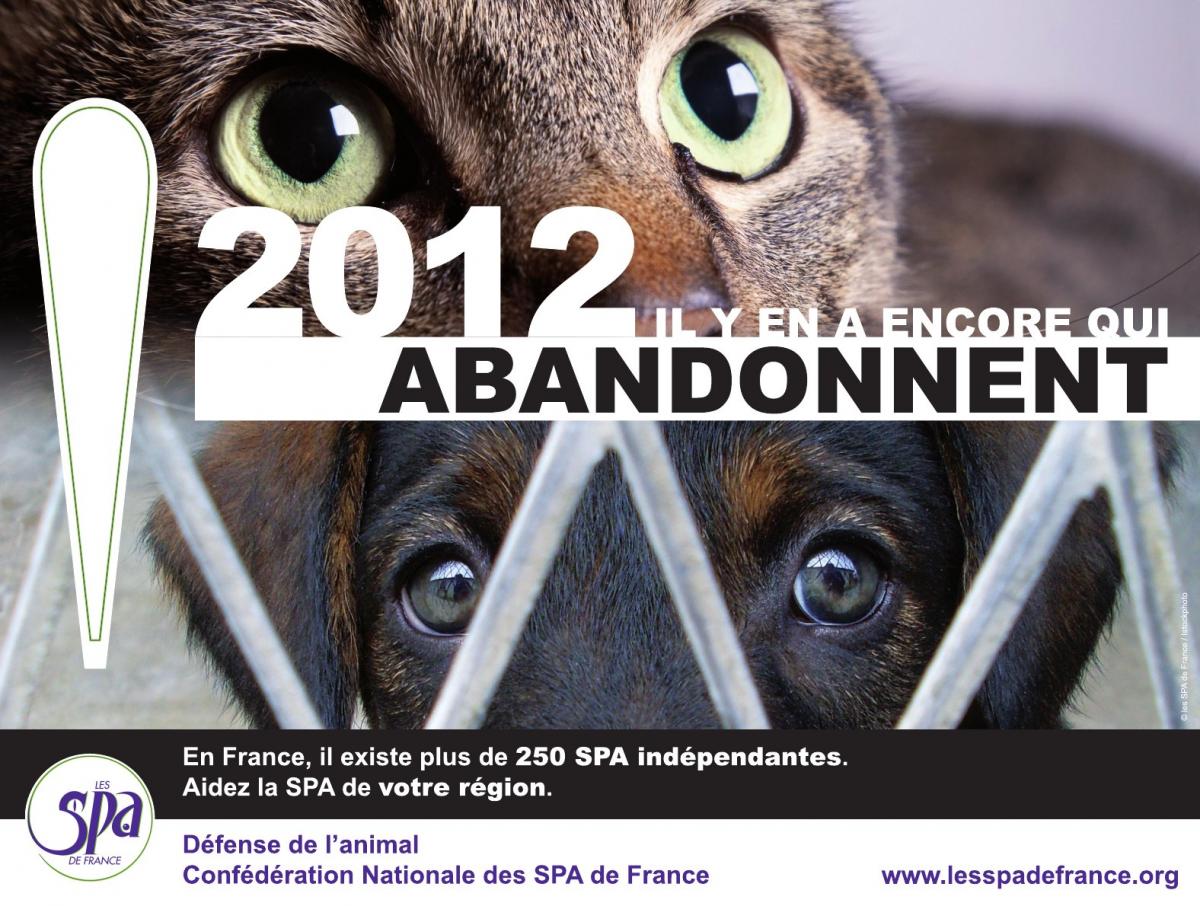
This year's campaign poster by the Confédération Nationale des SPA de France. The slogan reads "[In] 2012, there are still some [people] who abandon".
Despite the depressingly high figures, Giroud claims the annual campaigns have at least convinced more owners to sign their pet over to a shelter, rather than abandon it in the street. This is small comfort, surely, so what more can be done? Giroud calls for two things:
• “Support at the political level” in France. This means changing the legal status of animals (currently, an animal has the status of personal property, not that of a living being). This change is a long-standing demand of French animal welfare groups.
• Tighter regulation of pet shops, and of online pet adverts.
But evidently, more French pet owners still need to understand the basic message behind that simple but effective slogan: “A dog is for life, not just for Christmas”. The tagline, coined by the UK's Dogs Trust back in 1978, appears as relevant as ever.

Follow me on Twitter:

Search
Latest stories
Group categories
carolineclarkson
- Angela Merkel (1)
- animals (5)
- Austria (1)
- Barack Obama (1)
- bashar al-assad (1)
- Brexit (1)
- British politics (1)
- Charlie Hebdo (2)
- civil war (1)
- coffee (1)
- conflict (1)
- defence (1)
- democracy (2)
- Dominique Strauss-Kahn (1)
- EU (1)
- far-right (1)
- feminism (2)
- France (20)
- François Hollande (4)
19 Comments
Pets are the most important of our family. People are more interested in having more number of pets. But we should be careful on this day if we have a pet with us. We should definitely take some precautionary measures to avoid our pet’s day to be worse. We should take care of their food habits, we should provide only with those food which are been directed by the animal doctor. The above information is extremely helpful and informative.
This heartbreaking situation is too common in every country. I live in the United States in a sparsely populated rural area. People too frequently abandon their pets in my vicinity apparently thinking that the abandoned ones will be able to care for themselves in an area that is heavily forested. These animals come to my door not just because they are hungry but with broken hearts that the humans they have loved could toss them aside without conscience. The pleading in their eyes is painful to see but the joy they display when I invite them in rewards me beyond words to describe.
i can't imagine how one can abandon their pet! it is one of the most terrible things to do, once we take them home, we are responsible for them
I am truly shocked by this article. Having a French mother, we went to France quite often to visit family over the past 20 years. It was always a pleasure to see dogs sitting at cafes with their owners, well fed cats roaming through the village. All this cruelty was behind the curtain. I must say that in the States, we do a better job with abandoned animals. In every town, there are private, non-profit organizations who rescue all types of animals. I bought my two cats from an organization that resuces cats from a "kill shelter" in North Carolina. It's called a kill shelter because they are overwhelmed and have to dispose of some of the animals. I live near Rock Creek Park in Washington, DC. We have an organization that manages the feral cats in the Park. We capture them, neuter them and release them if they cannot be rehabilitated. There are several of us who have feeding stations and we feed them every day. It does take a volunteer spirit and dedication to have local shelters. Volunteerism isn't a strong point with the French.
These people are Selfish. A pet is a member of a family, not a prestige thing to walk around with and be noticed. This is very sad. Asians will eat your cats.Those who abonden there animals are animals themselves.The country of L'Amour has dropped some admiration in my opinion. Make sure your next Pate isnt dog meat. That would serve your superficial selves well.
The French are perhaps the most uncivilised of people. They have no respectfor anyone, let alone pets. It is a country of louts without any moral compass
Easy to solve it. Prohibit breeders. No more reproduction of animals in France or elsewhere. Humans are worse than animals. If people are capable of treating their pets like this, I wonder what they do to their own "human" children.
That's nothing! In the USA we abandon about 14 million pets each year - 75% of which are put to death! Stop buying at puppy farms & rescue an animal instead!
Post new comment